The bodybuilding debates will never end. The endless arguments over how an effective muscle building program should be structured will most likely continue until the end of time.
Just scour the Internet message boards, flip through any muscle magazine or talk to the sales rep at your local supplement store. No matter who you talk to or what you read, it seems that everyone is an expert these days.
If everyone is an expert, confident in their own ideas and beliefs, how can the average beginner possibly know who to listen to? He or she is instantly confronted with endless questions that seem to have no clear-cut answer. How many days should I train per week? How many sets should I perform for each muscle group? What type of rep range should I be using? What are the most effective exercises for stimulating muscle growth? How long should my workouts last? 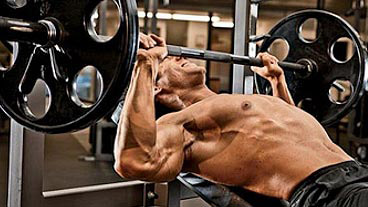
These questions go on and on until he or she is eventually led to believe that building muscle is an infinitely complex process involving rocket-science precision and an intimate understanding of human physiology.
I mean, that’s what takes to build muscle, right? Wrong!
Believe me, there are answers to these important questions, and if you are willing to put in the time and effort you will most definitely find them.
But that’s not what this article is about.
You see, amidst all of the confusion and endless debating, the majority of lifters end up losing sight of the big picture. Beyond all of the specific workout principles, such as rep range and exercise selection, remains one crucial principle, a principle that lies at the very heart of the muscle growth process.
If this principle is not given full attention, or even worse, completely ignored, building muscle becomes next to impossible. The bottom line is that muscles grow as they adapt to stress.
When you go to the gym and lift weights, you create “micro-tears”
within the muscle tissue. Your body perceives this as a potential threat to its survival and reacts accordingly by increasing the size and strength of the muscle fibers in order to protect against a possible future “attack”. Therefore, in order to continually increase the size and strength of the muscles, you must focus on progressing each week by either lifting slightly more weight or performing an extra rep or two. In doing this, your body will continue to adapt and grow to the ever-increasing stress.
Building muscle is all about building strength.
So what is the most powerful muscle-building tool available? Quite simply, it is a pen and a piece of paper!
Every time you go to the gym you must write down exactly what you accomplished and then strive to improve upon it the following week. If you aren’t always getting better, then you’re either staying the same or getting worse.

Every week you should have an exact plan of attack ready to be executed. You absolutely cannot afford to start throwing weights around aimlessly without a clear-cut goal in mind.
The specifics of building muscle are important to understand and implement, but regardless of what style of training you’re currently using the ultimate deciding factor between success and failure is progression. You can sit around all day obsessing over specific principles, but the bottom line is that if you aren’t getting stronger every week, you absolutely will not be getting any bigger. Examine your training approach closely. If you haven’t been paying laser-like attention to the amount of weight you’ve been using, the number of reps you’ve been performing, and then striving with every ounce of your energy to improve upon those numbers each week, you are completely ignoring the very foundation of the muscle growth process. If you want to see the best gains in muscle mass and strength that you possibly can, a pen and a piece of paper is the most important tool you could possibly have in your arsenal. |
Showing posts with label fitness. Show all posts
Showing posts with label fitness. Show all posts
Monday, 29 May 2017
body muscles the best tool

Tuesday, 23 May 2017
cardio exercise a scientific look
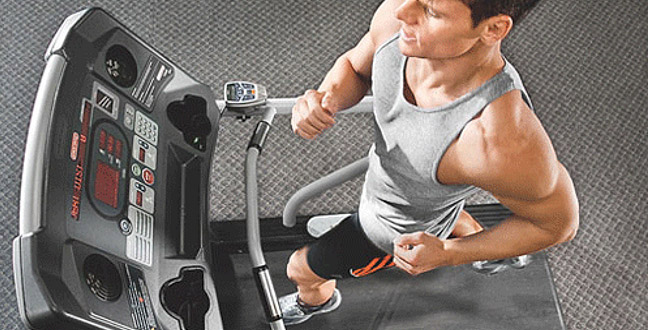 Performing cardio on an empty stomach (usually first thing in the morning after an overnight fast) has been a popular fat burning strategy among bodybuilders for many years.
It seems to make sense…
Since there is no food in the stomach, and since glycogen levels are low, the body will be forced to utilize more body fat for energy during the session. As a result, you’ll lose fat faster. But just like the “eat protein every 3 hours” rule, the post workout shake obsession and the “eat clean 24/7” approach, fasted cardio appears to be yet another piece of traditional bodybuilding advice that comes up short. Although this ultimately a highly complicated issue, let’s go over the key points… First off, the body is a far more intricate and dynamic system than most of us could ever imagine. Its specific use of fuel during exercise is constantly changing and is affected by a ton of different internal factors, such as different hormones and enzymes. The attempt to burn greater amounts of fat by exercising on an empty stomach is an extremely simplistic approach to a far more complex overall picture. Secondly, worrying about what happens in small spans of 30-60 minutes is an incredibly short-sighted view of fat loss. The process of losing fat is all about the big picture and what you do over the course of several days (not hours) is what’s really important.
For example, it appears that if more carbohydrates are burned during exercise, you’ll simply end up burning more fat later on in the day.
In the same way, if you burn more fat during exercise, more carbohydrates are burned later on. In other words, looking at overall 24 hour energy expenditure seems to be the most important factor by far. Thirdly, cardio on an empty stomach doesn’t appear to burn more total fat in comparison to having a meal first. Fasted cardio does appear to increase lipolysis (the amount of fat that is broken down), but does not increase fat oxidation (the amount of fat burned). In other words, fasted cardio causes the body to break down more fat than it can actually use for energy. And when it comes to fat loss, the limiting factor is fat oxidation, NOT lipolysis. In the end, those fatty acids that aren’t used for fuel are simply re-stored as body fat. Fourth, a pre-cardio meal increases the thermic effect of exercise. Not only does fasted cardio have minimal to no direct effect on fat loss, but fed cardio may actually be superior. This is because having a meal first appears to increase post exercise oxygen consumption (EPOC) due to an increase in thermogenesis (calories burned as heat). Fifth, performing cardio in a fasted state reduces exercise intensity. At the end of the day, effective cardio is all about maximizing the total number of calories burned. The more total intensity you generate, the greater the calorie-burning effect will be. In most individuals, performing cardio first thing in the morning on an empty stomach will have a significant negative impact on overall exercise intensity in comparison to having a meal first. Lastly, fasted cardio causes a greater degree of muscle loss. The research has shown that nitrogen losses are nearly doubled when cardio is performed on an empty stomach. If you’re aiming to burn fat while maintaining as much muscle as possible, fasted cardio is probably not the smartest choice.
So, to sum this all up…
Not only does fasted cardio appear to NOT increase fat loss during exercise, but it may actually lower the total amount of fat burned due to a decrease in post exercise oxygen consumption and overall training intensity. In addition, fasted cardio causes you to lose more muscle. Bottom line?
If you’re looking to maximize fat loss while minimizing muscle loss, it’s probably best to get a meal in at least a few hours prior to your cardio sessions.
Fasted cardio does not produce any clear fat burning advantages, and if anything, it may be counterproductive. |
Thursday, 27 April 2017
SUPPLEMENT body building

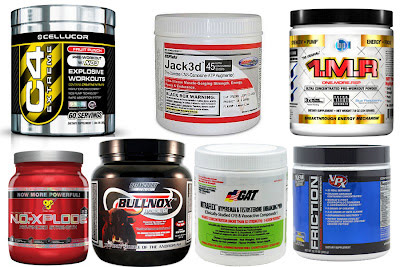
The “pre-workout” category of bodybuilding and fitness supplements has completely exploded over the last few years.
It seems that every supplement company (and that supplement company owner’s dog) has come out with their own “breakthrough” pre-workout formula promising huge increases in strength, performance, muscle growth and fat loss.
And although I always take a “No B.S” approach to every single supplement I review, there’s one very interesting fact about these products…
95% of them really DO work.
Yes, despite the hundreds (perhaps thousands) of different variations of pre-workout products lining the shelves at supplement stores across the country, the vast majority of them really DO increase muscular performance, mental focus and energy levels.
Amazing, right?
Well, not so fast.
See, there’s one common denominator here that makes this so. One very simple, anti-climactic fact…
Virtually all of them contain 100-300 milligrams of caffeine anhydrous in each serving.
No, the effectiveness of the majority of these products is not due to the “latest breakthrough research” in sports supplement science being released to the public for the very first time… It’s not the magical combination of ingredients hidden behind that top-secret “proprietary blend”… and it’s not the fact that it was formulated by alien-hybrid Russian scientists in an underground Siberian bunker…
No, in most cases, it’s mainly just the caffeine.
Before I go further, let me make this clear…
I am NOT saying that caffeine is the only ingredient research-backed to deliver acute effects on strength and performance in athletes. And I am NOT saying that there are no effective pre-workout formulas out there for a reasonable price that include other ingredients beyond caffeine. (Though I can only think of a couple off the top of my head)
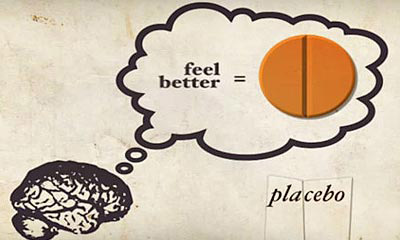
All I’m saying is that the majority of the effects you feel 30-45 minutes after sipping on that Radical Rockin’ Raspberry Rush (or, whatever) pre-workout drink is simply a combination of the study-dose of caffeine anhydrous (here is a good summary of the research on caffeine’s positive, measurable effects on strength and performance) and the basic placebo effect you experience when you consume a product with the positive expectation that it’s going to work.
Yes, I think l-tyrosine is a good pre-workout ingredient as well.
ALCAR can have some noticeable effects.
Citrulline malate may provide a small boost if you prefer a non-stimulant.
And yes, there are a few others out there that might be worth experimenting with as well, but they are few and far between.
However, none of these compare to basic caffeine – not in effectiveness, not in price.
And this is where the real problem arises…
It arises when any supplement company out there (or some random dude off the street – literally) can slap together 10, 20, 30 ingredients or more into a bottle (most of which are either totally ineffective, or somewhat effective but under-dosed), toss in a couple hundred milligrams of caffeine, hype the ever-living dog crap out of their product and then charge $67 a bottle for it.
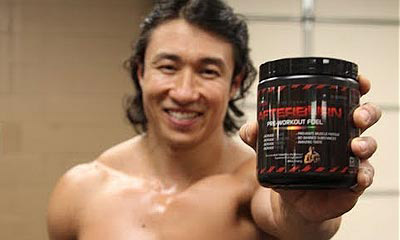
Yes, the product theoretically “works”, but unbeknownst to the person using it, they could have replicated most or all of its effects by just purchasing a bottle of caffeine anhydrous tabs for $4.
People often become defensive when I try to point this out, because they don’t want to hear that they’ve essentially wasted $40 a month or so for the past 3 years on the pre-workout product they’ve been using.
That’s understandable, but my only goal here is to help, and it should be seen as a positive thing since you can now use that $40 a month on things that actually matter… like food or your gym membership.
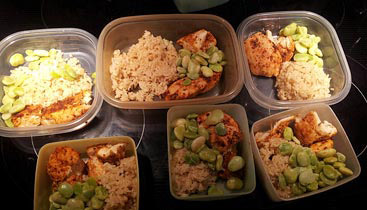
And as someone who has been researching bodybuilding and fitness supplementation for the last 12 years and who has owned a small supplement company in the past as well, I can tell you with certainty that most (definitely not all, but most) of the pre-workout category is a straight up hustle.
People often cite “flavoring” and “convenience” as benefits of using a pre-workout supplement…
But c’mon, flavoring?
Mix your pre-workout ingredients with some Crystal Lite, MiO or juice and it’ll taste just fine. Many of them are in pill form anyway.
And given that there are only a VERY small handful of pre-workout compounds even worth bothering with in the first place, I don’t see how “convenience” justifies the insane increase in price.
Besides, if you buy your pre-workout ingredients separately it will allow you to experiment with different dosages, or modulate the potency if necessary depending on your mood, energy levels or on the specific type of workout you’re performing.
I get that the marketing, fancy packaging and all that makes it “feel good” to use the product - but let’s come back to reality here.
Simple truth: The best pre-workout supplement available, by a good margin, is basic caffeine anhydrous at 100-300mg 30-45 minutes prior to training.
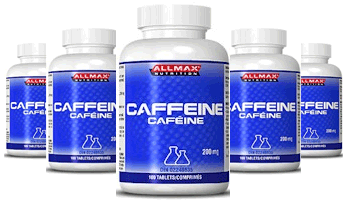
And the best part is, it will literally cost you a couple cents per serving.
If you want to create a small pre-workout stack and boost the effects further, add in 1-3 grams of l-tyrosine (also very inexpensive) as this amino acid works downstream from caffeine to increase energy and mental focus further.
If you still want to push things a bit further, acetyl l-carnitine (ALCAR) might be worth adding at a dosage of 1-2 grams.
Finally, if you’re sensitive to stimulants OR you want a full-on pre-workout stack that completely maximizes your performance, you can experiment with citrulline malate at 6-8 grams. (Though the research here is not extensive)
All of these ingredients would be taken 30-45 minutes before your session, ideally on an empty stomach. I’d also recommend only using them a few times per week, and taking a full 2 weeks off after 6-8 weeks of continued use.
What you personally decide to do will depend on your budget, sensitivity to stimulants, the effects you experience etc.
Many of you won’t even want or need any pre-workout ingredients at all (besides your pre-workout meal and perhaps a strong cup of coffee)… and all of you certainly don’t need an over-hyped, over-priced, under-dosed, under-researched (I could keep going here but you get the point) fairy-tale pre-workout blend that does not benefit you beyond 1 or 2 dirt-cheap ingredients and that may even be potentially dangerous to your health when used over the long term.
Wednesday, 1 March 2017
3 KILLER CHEST TRAINING TIPS FOR THICK, POWERFUL PECS

So you've been cranking out your chest pressing movements with full intensity down pat... and your chest still isn't growing the way you want it to?
You're not alone. While proper chest training may be simple on paper, the real key to explosive chest growth is in the execution. And this is an area where most trainees, quite frankly, royally screw up. Most people know that the core foundation of any effective chest workout is heavy pressing; barbell presses and dumbbell presses performed on either a flat, incline or decline bench. (Wide-grip dips also fall into this category) But as you probably also know, chest pressing is a compound movement that involves more than just the pecs. Your triceps and anterior delts (the front of the shoulder) are also heavily recruited. Yet, this is precisely the opposite of what most trainees do in the gym. By using incorrect pressing technique, their triceps and front delts get absolutely hammered, while their chest receives moderate stimulation and thus, moderate growth. The good news is that all it takes are 3 simple shifts in your form to immediately direct that muscle stimulating tension OFF of your triceps and shoulders and straight onto your chest. Apply these 3 tips below and you'll be amazed at the difference you feel... Keep your shoulder blades retracted throughout the movement.  By pinching your shoulder blades together and keeping them there as you press the weight up and down, your pecs end up taking on more of the load. You can test this out for yourself right now as you read this... Perform a regular pressing motion with your shoulder blades completely flat. Now perform one with your shoulder blades retracted.
Feel the difference?
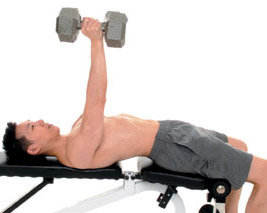
Push through elbows rather than your hands.
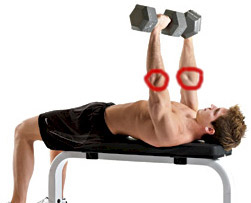
This one takes a bit of getting used to but will make a huge difference in your ability to limit tricep/delt involvement and maximize chest stimulation.
The simplest way to describe this is to pretend that your hands and forearms don't even exist. Instead, place 100% of your focus on simply pressing your elbow up and across your body. When you press through your hand, your triceps become heavily involved in the movement. By pressing through your elbow, triceps involvement is minimized while pec involvement is maximized.
Get this one nailed down and the difference you'll feel in your chest will be like night and day.
Retract your shoulder blades. Arch your lower back. Press through your elbows. Greater pec stimulation, greater pec growth.
I should note that if you do employ these techniques as outlined you will have to scale back a bit on the amount of weight you're using. That's because when you execute these tips properly, most of the stress is placed onto the chest while the surrounding muscles are largely taken out of the equation.
This is completely fine and should not be something to concern yourself with.
Bodybuilding is about exactly that - building your body. And building your body is a direct function of the amount of overload you place onto the target muscles and NOT about the objective amount of weight you're lifting.
If your primary concern during a chest workout is to impress the girls at the gym (who, by the way, could care less about how big your bench press is) then that's up to you...
But if you really want to build your pecs with maximum efficiency and pack on as much muscle size as possible, leave your ego at the door. Instead, put all of your focus on maximally recruiting your pecs through proper form (as described above) and a good mind-muscle connection.
Happy chest training.
If you found this information helpful get more here
|
Tuesday, 28 February 2017
workout
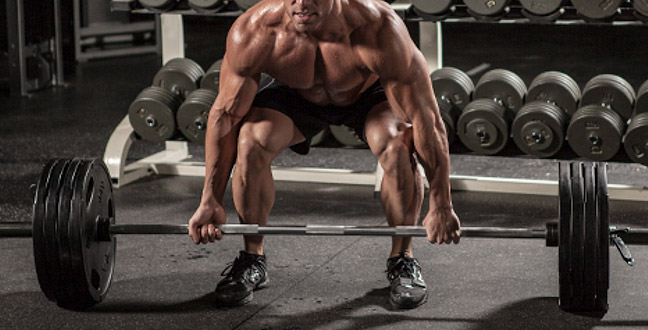
Today, I’m going to share with you a legitimate, science-based technique that will allow you to instantly add around 5-10 pounds to all of your major compound exercises in the gym, and squeeze out an extra rep or two on your smaller isolation lifts.
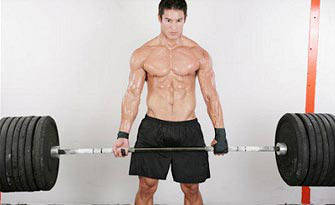
It’s dead simple, and requires almost zero effort to employ.
From now on, whenever you perform a set of any exercise, lock your gaze onto a single point in front of you and do NOT let your eyes wander or the positioning of your head to change.
Pour ALL of your intensity, drive and motivation into that one point of vision as you crank out each rep, and maintain it with full focus until your set is over.
How exactly does this help to increase your strength and power in the gym?
It all has to do with “proprioception”, which is a process used by your central nervous system to give you an automatic sensation of where all the different parts of your body are located relative to each other in any given moment.
For example, if I asked you right now to touch your left ear, or your right elbow, you’d instantly know where to move your hand in order to locate that body part without even having to think about it. It’s something we take completely for granted, but without proprioception, this wouldn’t be possible.
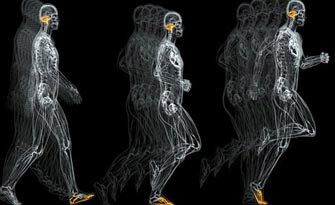
Now, here’s the important thing to realize when it comes to performing any given exercise in the gym...
Every time your eyes move around or your head positioning changes,
your body must “reset” proprioception to determine where all the parts of your body are now located.
If you were looking straight ahead and then turned your head completely to the left, the relative positioning of all the different parts of your body would instantly change. (This is why it becomes much harder to maintain your balance if your eyes and head are constantly in motion)
So, by keeping your vision locked onto a single point in front of you and not allowing your head to move around as you lift and lower the weights, proprioception remains constant and does not have to continually reset itself.
This increases the overall efficiency at which you can move the resistance, since your body can now place 100% of its focus on simply powering the weight up and down without these constant “resets” in proprioception getting in the way.
Don’t expect anything too crazy, but a 5-10 pound increase on major compound exercises is not uncommon, along with an extra rep or two on smaller isolation lifts.
Since achieving muscular hypertrophy is all about progressively overloading your muscles with greater and greater amounts of resistance over time, the instant boost that this technique provides is definitely worth it.see more
|